
Searching the Apex Court Docket
Run any Apex state-court matter through the North Carolina eCourts Portal. When a public result appears, it opens a Case Summary or Register of Actions. Both cover the Wake file. The most precise search is a complete number ending in -910. Portal also supports documented citation-number and name routes. A Town of Apex parking ticket stays in the town process. That is the default. It moves only if the notice is a Uniform Citation or points you toward court.
- Identify the paper: Town parking ticket, town administrative notice, North Carolina Uniform Citation, police report, or existing Wake court filing.
- For a court-facing citation or file, enter the citation number or complete Wake number into Smart Search.
- Use Wake County, category, status, and filing-date filters after basic criteria are supplied.
- Open the Apex-origin case result and check its Case Events, Hearings, Disposition, and public documents.
- Compare a scheduled date with Search Hearings and the current Wake calendar. Use the Wake Clerk channel for a date change or a close setting.
Remember what Portal is. It is a public display layer, not an official record and not a Town parking-payment system. If Apex court information is missing, keep the exact citation or case detail and go to the Clerk or a public terminal rather than substituting a town administrative form.
Apex Parking Tickets and State Citations
Apex shows the county's clearest local split between parking tickets and state citations. The Town's FAQ says parking tickets can be paid through Town Hall or Finance. It uses the town process. State citations take the court route instead. The Town's parking-ticket review form has one scope. It covers only Town of Apex parking tickets. The FAQ is explicit on one point. A parking violation written on a North Carolina Uniform Citation must be answered in Wake County District Court.
| Apex paper | First channel | Important boundary |
|---|---|---|
| Town parking ticket | Town Finance and town review process | Not automatically an eCourts case |
| Uniform Citation or state citation | Wake District Court, Portal, and Clerk | Not a Town parking-review request |
| Apex police report | Apex Records Office | Not a Clerk-held court document |
Apex's official FAQ spells out how court dates and payments get routed. Let the issuing document set your path, not the city name alone.
Before you pay, request a review, or chase a court date, read the ticket's source, number, and response language. A town parking-review procedure is not a Wake court continuance.
Apex Municipal Court Basics
Apex operates no municipal state-court docket. There is no city court calendar, city court clerk, or municipal judge docket of its own. Town hall can produce town notices and town parking records. But public state court cases tied to Apex live in the Wake County system. The Wake County Clerk of Superior Court is the local custodian for District Court and Superior Court files alike.
Wake County District Court is the usual entry point. It covers traffic, infractions, misdemeanors, many family matters, and lower-level civil matters. Superior Court handles felony trials, major civil matters, and certain appeals. The court category and file number set the active court route. Apex Town Hall history does not matter. Nor does a town address.
Note: The former town hall's historical jail and police role does not make it a present court-docket archive.
Apex Court Date Change Route
Apex's FAQ gives one number for a court-date change. Call the Wake County Clerk of Court at 919-792-4000. That instruction is specific and worth following. Court-date change information belongs with the court custodian. It does not belong with Apex Finance or a parking review form. Before calling, have the court or citation number and the printed date in hand.
Open the public Register first if you can. Note the case status, the latest Case Event, and the next visible hearing. Suppose a Portal result and a calendar seem to disagree. Get current confirmation from the responsible court. A Town payment option tells you nothing. It does not settle whether a required appearance applies. The same goes for a continuance request or a later officer-present trial date.
Court Dates and Settings in Apex
Apex court dates are Wake court settings. Portal Search Hearings lets you filter by Wake location, hearing type, search type, and date range. You can also pick a case, party, attorney, judicial-officer, or courtroom selection. Wake local schedules add amended weekly calendars alongside longer civil, criminal, District, and Superior schedules. Use the Portal Register and a current hearing search together. A general schedule is not a specific case record.
| Date | The current court day in a hearing search or posted applicable schedule. |
|---|---|
| Time | The listed setting time, separate from a court's case-call practice. |
| Courtroom | The Wake courtroom or location assigned to the state case. |
| Judicial officer | The officer or court context selected in the Search Hearings query when available. |
| Setting type | The applicable civil, criminal, family, probate, or mental-health hearing category. |
Search Hearings cannot tell you whether a setting is virtual or in person. A near-date Apex court setting deserves a call to the court. Ask about remote details, call order, and any amendment.
Apex Police and Court Records
For an agency report, the Apex Police Records Office is a separate route. Its request process can require report details, a date, names or parties, an officer name, and city request information. The Wake Clerk asks for court-file details instead: the complete number, the document, the date, and the requested copy type. The two systems can involve the same incident, but they share no public lookup interface and no certification role.
Keep both numbers if both exist. An Apex report number helps locate an agency record. A Wake -910 number opens a court file. Do not ask the town records office for a court disposition or a certified Wake court document, and do not expect the Clerk to hold the police report.
Traffic Tickets in Apex
Not every paper you get in Apex belongs to the same office. A state traffic citation becomes a Wake court matter once it carries state court directions. It also becomes one if it turns into a Wake case. Pull the citation number into Portal. Check that the result is the Wake case. Then read the newest Register and hearing details. A Town of Apex parking ticket works the other way. Follow the town's own instructions, because an online court payment is not a payment option for every Apex parking paper.
Wake Administrative Traffic Court serves a narrow administrative purpose. The officer who wrote the ticket does not appear there. No officer-present trial happens in that setting. If you want to contest a state citation, follow the active court process and its current date. The Wake traffic tickets page lays out the countywide Portal, calendar, Clerk, and copy channels.
Apex Uniform Citation Court Path
The Apex parking-review material builds a useful decision tree. Step one is simple. Decide whether you hold a Town parking ticket or a state Uniform Citation. Step two: Town Finance and the town review procedure apply only to the town parking ticket. Step three moves a Uniform Citation or any other state citation onto the Wake eCourts route. That route also covers the calendar and Clerk. Step four, if a court appearance or contest is needed, follows the current court instruction rather than a town payment option.
Treat this as a routing rule, not a promise of outcomes. It does not guarantee that every state citation can be paid online, changed, or resolved the same way. What it prevents is the local mistake. That mistake is filing a court matter through an Apex town administrative review.
Where Apex Cases Go
Apex state court cases land in Wake County channels. A town parking ticket stays inside the town's administrative route. A North Carolina Uniform Citation, or any other state-court matter, becomes a Wake file once filed. Criminal, infraction, and traffic cases run through the Wake County Justice Center. Civil cases go through the Wake County Courthouse. Across these trial divisions, the Clerk keeps the court record.
Docket flow: Apex town parking ticket › Town Finance or town review process. Apex Uniform Citation or state court process › Wake County District Court file › eCourts Register, Wake calendar, and Wake Clerk.
An Apex Police Records Office request can run alongside that flow when you need an agency report. It stands apart, though. It neither replaces the Wake case record nor creates a case number.
Apex Court Copy Requests
Apex counted 58,780 residents in the 2020 Census. Population never changes who keeps the file. For a public Apex-origin state court copy, give the Wake Clerk the complete file number, the case category, and the document name and date. Say whether you need a plain copy, a certified copy, or some other authentication. Portal helps you locate the public file. It is not itself a certified record.
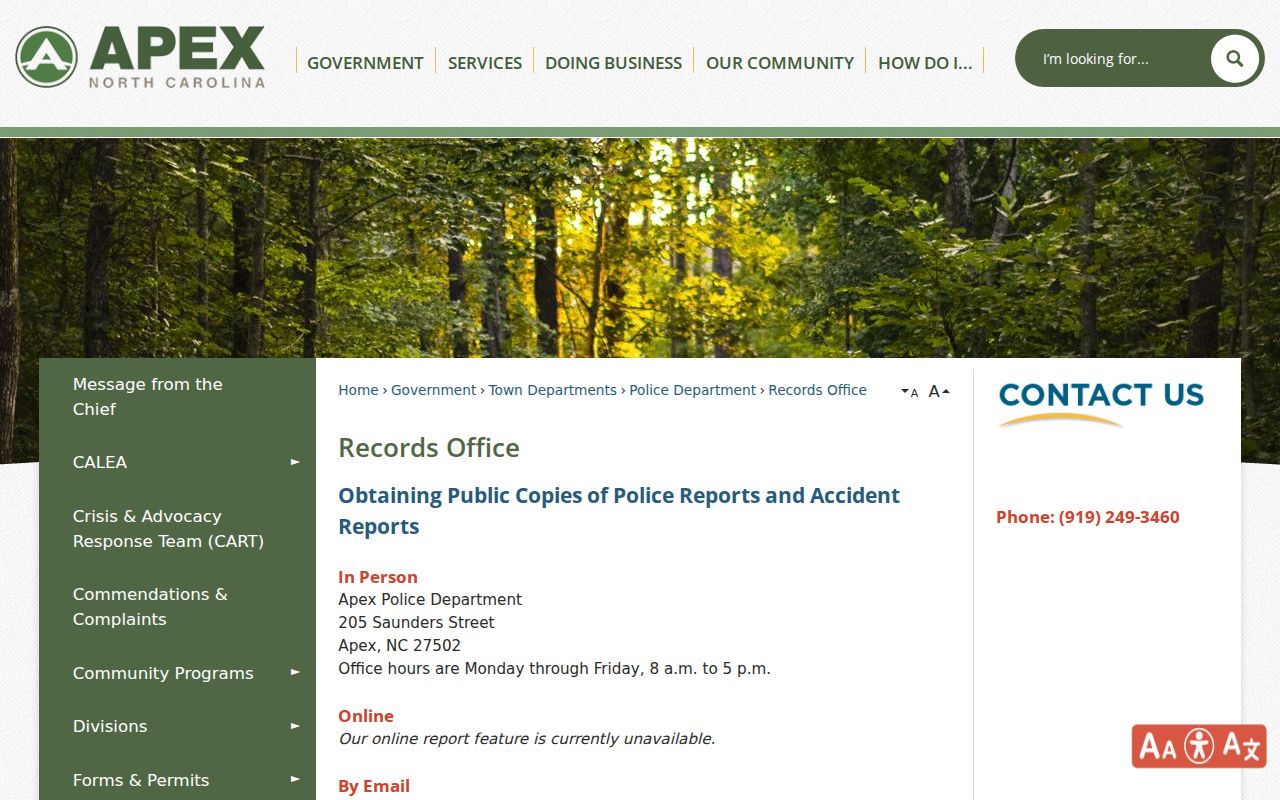
Apex's Records Office information shows the separate agency-record channel. That page marks a real boundary: town police records and Wake court records sit with different custodians.
Current statewide fees for a court file run $2.00 for the first copied page. Each additional page or fraction costs $0.25, and a certificate under seal adds $3.00. Ask the Clerk to confirm the current cost and the request method.
Apex History and Court Dockets
Apex historical material mentions an earlier Town Hall that housed a jail and police station. Nice trivia, wrong office. That fact belongs to town history, not to the present docket route. No current public state-court record lives in a historic town jail book. None lives in an Apex municipal docket either. Once a state court matter is filed, it rolls into the Wake Clerk and eCourts environment.
The distinction matters when an older local reference seems to point you toward a town institution. For a current Apex court case, keep the Wake citation or file number handy. Read the Register of Actions. Use the Wake calendar and Clerk for the active setting and record. A town historical source cannot confirm a current court status or substitute for a certified court document.
Apex Court Record Access Rules
Apex-origin Wake court records stay public only as far as North Carolina law allows. Court orders also set the limit. N.C. Gen. Stat. § 7A-109 puts the Clerk in charge of records, files, dockets, and indexes. They are open for public inspection unless access is prohibited. Start with Portal. Then use a public terminal, the Clerk counter, or a direct subject-specific line for a public file or official copy.
Key Rules:
N.C. Gen. Stat. § 7A-109 addresses Clerk-maintained court records and public inspection.
N.C. Gen. Stat. § 132-6.2 allows public-record copying and special-service costs in the stated circumstances.
N.C. Gen. Stat. § 7B-3001 protects juvenile law-enforcement records from public inspection.
A public Portal user cannot see sealed or confidential court materials. A missing Apex result can come from legal limits, indexing, timing, a transfer, or an input mismatch. It proves nothing about a case outcome.