
Getting Wake County Court Records
The Wake County Clerk of Superior Court keeps the files for Superior Court. It also keeps the files for District Court. That covers felonies, traffic, misdemeanors, civil, family, small claims, estates, and special proceedings. Before you ask for anything, gather the file number, the case type, and the parties or caption. Include a description of the document. Decide whether you want a plain copy, a certified copy, or an exemplification. Know too whether you want an audio record. Wake case numbers commonly end in -910. For online viewing, the North Carolina eCourts Portal offers the public Register of Actions. It is also called the Case Summary. You can see current case information, hearings, and whatever public documents are posted there. Anonymous users pay nothing. Remember that the Portal is only a viewing layer, not the official record. A plain copy simply reproduces a filed public document. The Wake County Clerk of Superior Court authenticates a certified copy. An exemplification is a higher form of authentication that must be scheduled separately.
- Search Portal by the complete Wake County number or a documented name and record the case type, case number, event, or document sought.
- Choose the record type: Case Summary, available public document, plain copy, certified copy, exemplification, judgment transcript, or nonconfidential audio copy.
- Select the channel. Use Portal for viewable public material; the Clerk counter or public terminal for inspection; telephone for case-category routing; and mail only after the Clerk confirms the request requirements.
- Give the Wake County Clerk the number, caption, division, document name or date, copy type, return contact, and any hearing date or courtroom needed for an audio request.
- Confirm the fee and payment method, then check the returned copy against the file number, document date, and certification need.
Wake County routes phone calls by subject. Call the line that matches your need rather than making a general request. Clerk offices across the state also provide public self-service terminals. Anyone may inspect a case file in the county where the case sits. Wake took part in early kiosk deployment. The counter can confirm current kiosk placement or printing options.
Wake County Court Record Channels
Wake County's channels are layered. Not every court record can be downloaded as a public document. The online Portal works well for public material. In person, the Wake County Clerk of Superior Court offers a public terminal. It also offers permitted file inspection and copy ordering. Phone lines suit subject-specific questions. The Wake County contact directory lists direct numbers for traffic and misdemeanors, felonies, record checks and expungements, judgments, small claims, pending civil and family cases, estates, and special proceedings. Mail works only after the Clerk confirms the request. The Clerk must also confirm the current fee, the return method, and payment details. Wake's payment page gives a PO Box and payment rules for eligible mailed payments. That page does not create one universal mail-copy procedure, though. Never send cash or a personal check by mail. Do so for no payment the Wake page governs. The contact page publishes a special-proceedings email and a special-proceedings copy-request email. But no general civil or criminal copy-request email exists. A Wake County court record search should not assume one does.
| Channel | Wake County use | Boundary |
|---|---|---|
| Portal | Public Case Summary, hearing information, and available public documents. | Not certified and not a substitute for the official court file. |
| Clerk counter / public terminal | Permitted public file inspection, copy purchase, and record routing. | Use the building and case category that match the file. |
| Telephone | Direct record-family routing through the Wake contact directory. | Provide the file number and copy type if known. |
| Potential copy-request path after Clerk confirmation. | Confirm fees, return method, and permitted payment before sending. | |
| Special-proceedings email | Published category-specific email channel. | Do not treat it as a general Wake court-file email. |
| NCAOC request form | Administrative Judicial Branch records. | It does not fulfill local Wake court-file requests. |
Civil matters belong to the Wake County Courthouse page channel. Criminal matters and marriages run through the Wake County Justice Center. The same Clerk keeps the files across both trial divisions. Routing in Wake County starts with the case category. A civil or estate request takes a different counter route from a criminal or traffic matter. The Clerk is the custodian in either location. A caller who names the record type first will settle payment and delivery questions far faster.
Court Record Types
A Wake County court record is not one single thing. The Register of Actions, or Case Summary, is the public timeline on the Portal. Filed documents are the pleadings, orders, judgments, and other papers sitting behind those docket entries. Only the Clerk certifies, not Portal. Sort out these forms first. Otherwise your request may go to the wrong office or treat an online view as an official copy.
- Public Case Summary or Register of Actions, with case information and chronological Case Events.
- Available public filed documents, including pleadings, orders, and judgments where Portal display and access rules permit.
- Plain copies of public court-file documents from the Wake County Clerk of Superior Court.
- Certified copies carrying the Clerk’s official authentication.
- Exemplifications, judgment transcripts, and nonconfidential audio requests that use their own Clerk process or form.
The Wake County Clerk's records do not automatically include police reports, birth records, death records, or deeds. They also do not include other agency files. Those live with different custodians. A court case may reference them. But a mention does not turn them into a Clerk-held document. Keep an available audio copy distinct from a written transcript prepared by a reporter or transcriptionist. Record type also drives the right proof of authenticity. A Portal view helps with public information, yet a plain copy is something else. A certified copy carries the Clerk's authentication, and an exemplification is its own separate request. Choose the copy type first so the Wake County request matches the service you actually need.
Wake County Court Record Views
The free Portal view lets you browse case history. Documents posted for public case types appear there too, but this view is not a certified court record. Per the Portal FAQ, official copies come from the county Clerk, not from the internet system. A case may show up in a Wake County search while a particular document stays hidden. Information can be sealed, confidential, restricted, or protected. A visible case shell in the docket does not unlock it.
The Judicial Branch records guidance describes public self-service terminals. Criminal searches by defendant, case number, victim, or witness are supported, along with civil, special-proceeding, and estate system information. You can view the case file at the county where it sits. For a copy, an inspection question, or an official record, use the Wake Clerk. Do not rely on a downloaded screen.
Think of the Portal as one public viewing route. A Wake County terminal is the in-person alternative. A certified copy comes only through the Wake County Clerk, never from a Portal printout. The local file remains the source.
Record distinction: Portal provides a public case view. The Wake County Clerk provides the official local court-file copy and the certification when one is needed.
Inside a Wake County Court Record
The public Case Summary is a structured view of the Wake County file. Its sections appear only when information exists. Expect case and assignment information, public party information, chronological Case Events, dispositions, hearings, applicable financial information, and any available public documents. Civil, family, probate, and mental-health matters can also display Causes of Action. Those claim categories are not a public criminal-charge search tool, though. A criminal docket question needs a different lookup.
| Case number | The Wake County file identifier, commonly in a four-part form ending in -910. |
|---|---|
| Case Information | Category or type, Wake location, status, and other case-level data. |
| Assignment Information | Entered court or case-assignment details. |
| Pleadings and documents | Available public filed materials. A restricted or sealed document may not display. |
| Orders and judgments | Filed rulings or judgment materials when public and available through the record channel. |
| Case Events | The time-ordered Register of Actions, including recorded case activity. |
| Hearings and disposition | Scheduled hearing information and outcome detail where those sections have data. |
| Financial Information | Applicable public financial detail. Confirm current totals with the Wake Clerk. |
Portal's separate Judgment Search is an index, and its figures may reflect the original judgment. The Register of Actions gives better Wake County case context. Neither screen replaces a certified copy or current confirmation from the Clerk.
Wake County Court Record Audio
To request an available nonconfidential clerk or digital audio record, use AOC-G-114, Request for Duplicate Copy of Verbatim Audio Court Record (Non-Confidential). Juvenile and other confidential proceedings are off limits. The form asks for the county, the District or Superior Court division, the case name and file number, and the proceeding date. It also asks for the presiding judge or clerk, the courtroom, your identity, your signature, and a telephone number. Those details let the Wake County Clerk of Superior Court locate the particular recording.
Delivery works a few ways. The Clerk may send an electronic recording through a time-limited LiquidFiles email link. Blank media such as a CD is another option. The charge is the actual cost of the blank media where available. Pay by cash, certified check, or money order made payable to Clerk of Superior Court. Personal checks are not accepted. A Superior Court reporter's original stenomask audio may require a court order after notice and good cause. A written transcript is a separate service. Its rates are set by reporters or transcriptionists.
An official NCAOC public-record request source lays out the agency's administrative request process. That process sits apart from any Wake County case-file request.
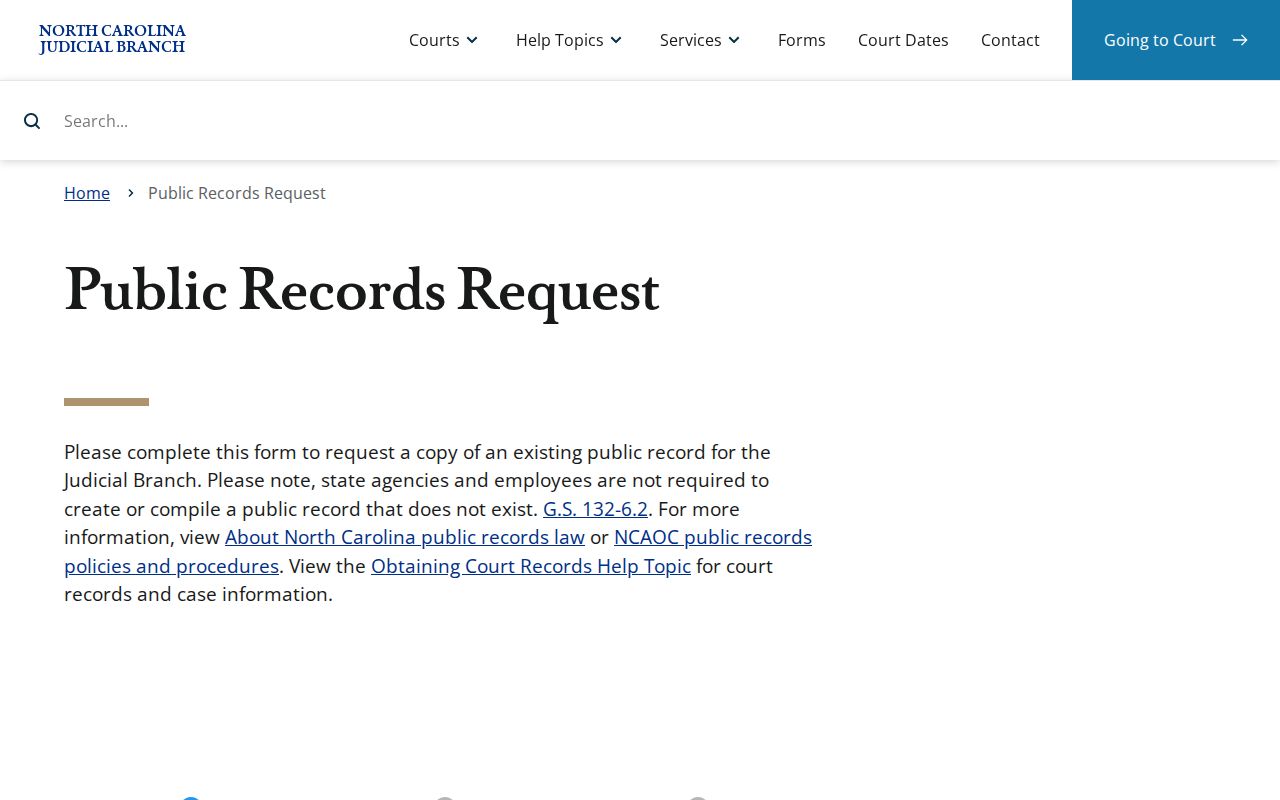
The form illustrates the NCAOC administrative-record channel. It does not replace the Wake County Clerk's local court-file process. An audio request needs more detail than an ordinary Wake County record search. The case number, proceeding date, division, courtroom, and presiding official all help the Clerk locate an available recording. Separate an audio copy from a transcript request, too. Ask the Clerk to process either only after that.
Fees and Certified Copies
The official miscellaneous-cost chart is effective January 1, 2025. Its statewide amounts serve as the published reference for Wake County Clerk services unless a newer chart appears. Portal public case search stays free. Note that the fee schedule splits preparation of copies from a certificate under seal, so a plain copy price and a certification charge are two different numbers. Exemplification is yet another distinct authentication step.
| Wake court-record service | Published amount or rule |
|---|---|
| Portal public case search | $0. No public registration is required. |
| Plain copy, first page of each document | $2.00. |
| Each additional plain-copy page or fraction | $0.25. |
| Certificate under seal | $3.00, separately scheduled from copy preparation. |
| Exemplification of records | $10.00. |
| Criminal record search | $25.00 statutory search fee, not a Portal charge. |
| Preparation and docketing of transcript of judgment | $10.00. |
| Court reporter transcript | No statewide amount in the record source; rates are set independently. |
| Nonconfidential clerk or digital audio copy | Actual blank-media cost where available; no fixed amount located. |
Wake County Clerk of Superior Court
Wake County Courthouse
316 Fayetteville St. Mall, Raleigh, NC 27601
(919) 792-4000
The Courthouse handles civil, estate, special-proceeding, judgment, and small-claims work. Criminal venue work uses the Wake County Justice Center at 300 S. Salisbury St. The Clerk's subject-specific phone lines help route a request. They bridge the two buildings.
Confirm fees before payment. A Wake County request can combine copy preparation with certification. A first page, an additional page, and a certificate under seal each carry different published amounts. Portal access remains free for public information. The Clerk charges the published service amounts for the record work you request.
Wake County Court Record Mail
Pick up the phone before you mail anything. Call the right Clerk of Superior Court line and verify that the court record copy you want exists. Ask what type of copy it is, the exact amount due, and how to pay. Also confirm how you want it mailed back. Ask whether you need it certified. Wake County's payment page then gives the mailing address: Clerk of Superior Court, Wake County Courthouse, PO Box 351, Raleigh, NC 27602-0351. By mail, send a certified check or money order. Cash and personal checks are barred.
Do not read those payment details as proof that any copy request can be mailed. Treat them as a final check on a request the Clerk has already confirmed. Write the request so a clerk can act on it fast. Include the file number, the caption, the division, the document description and its date, your choice of plain or certified copy, and your return contact. That detail prevents two common errors. The request may go to the wrong subject division. Or you may assume a certified copy can even be produced by mail.
A mailed request needs the same Wake County case information as a walk-up request. Confirm the copy type, the fee, and the return method first. Then confirm the whole request with the Wake County Clerk. Once that is done, your docket request is far more likely to land in the proper channel.
Sealed Records and Public Access
Public access in Wake County rests on N.C. Gen. Stat. § 7A-109. The Clerk keeps records, files, dockets, and indexes open for public inspection during regular office hours. Some other law can say otherwise. That statute favors openness. It does not override confidentiality statutes, sealing orders, or limits tied to particular data and documents. The online Portal is a convenience, not a way around those limits.
So sealed or confidential material never reaches public Portal users. Juvenile law-enforcement records stay withheld under N.C. Gen. Stat. § 7B-3001. Protection-order and domestic-violence dockets face added display restrictions. An expunged or sealed record will not appear online at all. Remember this when a docket search comes back empty. A no-result can mean an index delay, a transfer, a spelling error, or a protected category. It is never a conclusion about the case itself.
Wake access rules: Section 7A-109 supports inspection of Clerk-held records unless law prohibits it. Section 132-6.2 addresses actual copying and special-service costs. Section 7A-95(c) is reflected in the AOC-G-114 treatment of specified nonconfidential audio records.
Wake County Court Record Custodians
The NCAOC public-record request covers records the Judicial Branch agency itself holds. It is not the custodian of local Wake County case files. It will not produce court documents or case information that sit with the Clerk. The Judicial Branch request page draws that administrative line plainly. Route a local court-file request to NCAOC and you only add a detour.
Take local needs straight to the Wake County Clerk of Superior Court. That means the trial-court file, a certified copy, permitted public inspection, or a question about a specific record category. Reserve NCAOC for agency records it actually holds. A Portal case number sharpens either request. But the record type and who holds it still decide the channel. Need the file number first? The Wake County Case Lookup can supply it before you contact the Clerk.