
Wake County Court Calendars Explained
Wake County stacks its calendars in layers, and each layer does one job. For a case file itself, the North Carolina eCourts Portal carries the Case Summary. The courts also call this the Register of Actions. Its Search Hearings tool shows where and when a hearing is currently set. For the wider schedule picture, Wake County posts Local Administrative Schedules. Those pages include amended weekly calendars, District Court six-month schedules, 10th Judicial District schedules, Superior Court six-month schedules, and links to civil and criminal calendar pages.
One posted list, though, is never the whole Wake County court calendar. A hearing result on a case points to the setting tied to that specific file. A published calendar only shows the division, the session, the courtroom, or the broader schedule. So compare them. A call order may matter. So may a remote appearance instruction or a late change. Confirm those details with the Wake County Clerk of Superior Court or courtroom staff. One more caveat applies. Search Hearings does not say whether a hearing is virtual or in person.
Note: Use a calendar as a planning tool. Then check the latest Case Events before relying on any Wake County setting.
Wake County Calendar Sources
Start with the record itself. Skip the session list when you run a Wake County docket search. Search Hearings lets you query by case number, party, business, attorney, judicial officer, courtroom, or date range. For local context, the Wake Trial Court Administrator’s Office posts calendar resources and coordinator contacts. One caution: that office handles calendars, not filings. Anything you need to file goes through the Wake County Clerk of Superior Court.
For a revised weekly list, check Wake’s schedule page. It also covers longer civil or criminal session schedules. Still, the case Register and Search Hearings beat any schedule for pinning down a specific Wake County court date. Suppose those tools disagree with an older calendar. Trust the case-category Clerk line or the courtroom handling the matter. Treat the stale schedule as background only.
| Wake source | Best use | Important limit |
|---|---|---|
| Portal Case Summary | Recent case events, assignment, and hearing context | Public display is not an official certified record. |
| Portal Search Hearings | Current time and location search across cases | It does not identify virtual versus in-person status. |
| Published Wake calendars | Weekly amendments and civil or criminal schedule planning | A session does not guarantee a personal call time. |
| Clerk or courtroom staff | Near-date confirmation and call-order questions | Use the correct case category and location. |
A Wake calendar schedules source shows the official schedule channel.
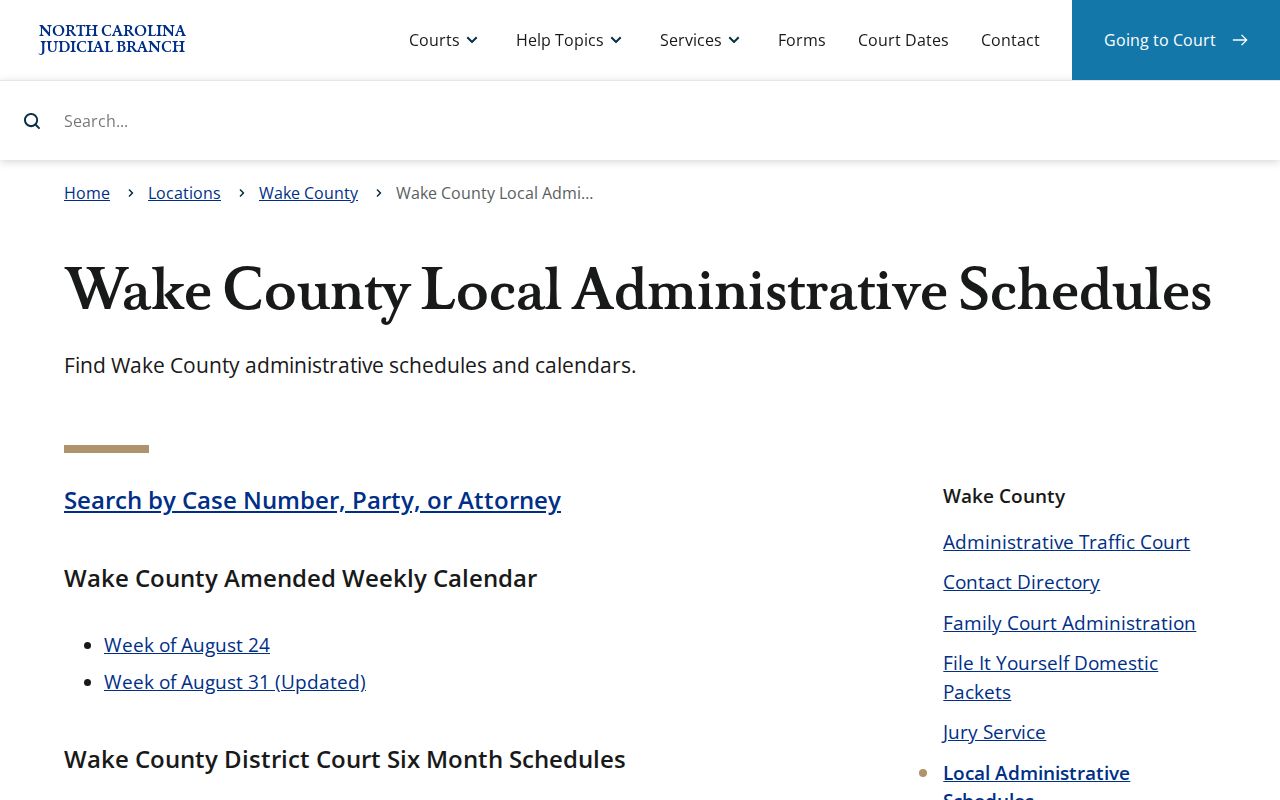
Wake County schedule links serve one clear purpose: confirming whether a calendar was amended before your hearing. That check matters. Calendar work tends to bounce between the individual case record and the broader session list. Wake County civil settings can run on a different calendar than Wake County criminal settings. So a session schedule alone rarely settles anything. For a hearing tied to one file, use the Wake County hearing search. Add the latest Wake County Case Events for far more certainty.
Finding Your Court Date
Got a case number? That is the fastest route to a Wake County court date. Wake files commonly end in -910. No number handy? Portal accepts last name, then first name, in that documented order. The most reliable docket search sequence stacks four checks. It covers the case record, the hearing tool, the published Wake County schedule, and direct confirmation from the court. That order also leaves you a fallback when a web result comes back incomplete.
- Open the eCourts Portal, choose Smart Search, and search the Wake County case number or documented name format. Set the location to Wake when narrowing a result.
- Open the underlined case number, then review the Case Summary’s Hearings section and its most recent Case Events. The older event is history, not proof of the next Wake County court date.
- Use Search Hearings with Wake County, the hearing type, a search type, the matching identifier, and a date range. Compare the returned time and location with the case record.
- Check the Wake local schedules for amended weekly calendars, civil or criminal calendars, and six-month schedules.
- Call the relevant Wake County Clerk of Superior Court line or courtroom staff when an online result conflicts, a remote link is needed, or a setting is close. The public may also visit the Clerk counter and ask where to find the current terminal or calendar information.
Wake County splits its phone lines by case type. Traffic and misdemeanors go one way. Felonies and small claims go another. Family, pending civil matters, estates, judgments, and special proceedings each route to their own desk. Rather than guessing which general counter handles your case, use the official Wake contact directory. It reaches the right office fast. The online court record does not cover every public file. When a docket entry you need is missing there, the Clerk's counter remains a reliable fallback.
Wake County Court Hearing Search
Inside the statewide Portal sits a separate Wake County calendar tool called Search Hearings. Its official user guide walks you through the required fields. You pick a location, a hearing type, a search type, and a date range. Then you enter the matching identifier or make a selection. Always choose Wake County first so the docket search returns local results. Keep the date range tight, too. The tool covers current hearings only. It is not a permanent list of every event recorded in the Register of Actions.
| Field | Type | Required | Wake use or format |
|---|---|---|---|
| Location | Dropdown | Yes | Select Wake County. |
| Hearing Type | Dropdown | Yes | All Hearing Types, Civil, Criminal, Family, or Probate or Mental Health. |
| Search Type | Dropdown | Yes | Case Number, Party Name, Business Name, Attorney Name, Attorney Bar Number, Judicial Officer, or Courtroom. |
| Case Number | Text | For that search type | Use the four-part Wake number, including -910. |
| Last Name / First Name | Text | For Party Name | Use the guide’s separate name fields. |
| Business, attorney, bar number | Text | For selected type | Use the matching documented search type. |
| Judicial Officer / Courtroom | Dropdown | For selected type | Know the precise person or room before narrowing. |
| Date From / Date To | Date fields | Yes | Required in the documented search flows. |
Wake scheduling materials also link a statewide option: the North Carolina civil calendar interface, which lists civil hearing dates across the state's court calendars.
Treat that civil calendar channel as a companion to the Wake County hearing lookup. It cannot replace the specific date and location tied to one case docket.
How to Read a Court Setting
A Wake County court setting carries more than a date. Search Hearings gives you the time, the courtroom, and the judicial officer. It also links back to the underlying case. That matters when you need the full story. The linked Register page fills in what the calendar leaves out: the case number, the parties, and the Case Events history. That history includes entries that show how a case has moved through the court, along with disposition context. Read the two sources together. A calendar result on its own cannot show the whole record. It also cannot tell you whether a remote hearing is an option.
| Date | The current scheduled date returned for the Wake County hearing search or shown in the latest case event. |
|---|---|
| Time | The listed hearing time or appearance window. It may not be a personal trial call time. |
| Location / courtroom | The Wake venue or room tied to the hearing. Check the current result before travel. |
| Judicial officer | Selected court or judicial-officer context when the search returns it, not a substitute for a courtroom call order. |
| Setting type | The hearing category, such as civil, criminal, family, or probate or mental health. It explains the purpose of the event. |
Note: Search Hearings does not say whether Wake County expects you to appear in person or by video. Confirm that procedure with the court directly.
Wake County Court Schedules
Wake County puts its court schedules out on more than one horizon. Civil Superior sessions appear in Spring or Fall six-month schedules and in amended weekly calendars. District Court civil settings run on six-month plans too. Those lists help a Wake County reader plan around a session. Still, a session assignment is not a specific motion time or trial call. For the live hearing result and current case events, the case-level docket check remains the place to look.
Criminal and infraction cases take their own Wake County calendar route. A single setting can move through continuance, plea, dismissal, trial, appeal, remand, or transfer events. Calendars answer when, not what happened. The Wake local rules and forms page holds the county's current calendar and continuance materials. Confirm any particular court date through the court itself.
That same Wake local rules source links to the official calendar and continuance resources the county publishes.
Wake County publishes schedules on several planning cycles. That is simply how its courts run. An amended weekly calendar can matter more than an earlier session schedule for a Wake County civil or criminal matter. Check both before you act on a date. The local rules also set the official route for forms and policies, which can affect a request to move a court date. Read the Wake County court record and the calendar together before relying on any single date.
Continuances, Resets, and Cancellations
A continuance just postpones a date. A reset is the new setting that follows. Either one can shift a Wake County hearing, so run a fresh Search Hearings lookup and the newer Case Events check afterward. Portal can show statuses and events like Transferred to Superior Court, Trial De Novo, Remanded, and Reopened. None of those labels alone proves an older Wake County court date is still active.
The amended weekly calendar explains why a printed schedule goes stale. Call orders also differ by courtroom and judge. Search Hearings sorts by courtroom and date. It cannot override the courtroom's own practice. For a call list, ask the courtroom clerk. Filings and continuance requests go to the Wake County Clerk of Superior Court, not the Trial Court Administrator. The Wake Trial Court Administration page names the local office that coordinates calendar resources.
Schedule questions can go through the Wake County calendar office for routing. Filings still belong with the Clerk.
Wake County Traffic Court Calendar
Administrative Traffic Court runs on its own Wake County calendar. On the scheduled date it sits in Courtroom 101 at the Wake County Justice Center, open from 8:15 a.m. to 4:00 p.m. You may appear any time during that window. This is an administrative disposition setting. The issuing officer is not present, and no trials are held in Room 101.
Contesting an infraction works differently. You must appear on the initial Wake County date. Ask for a continuance so the officer can be subpoenaed for a later trial date. The Wake Administrative Traffic Court page walks through the Room 101 check-in process and how it differs from a contested trial. Check the citation first, since it should point you to this channel before you assume the special appearance window.
If You Miss a Court Setting
An old online listing will not settle what happened at a missed Wake County court setting. Contact the Wake County Clerk of Superior Court or the responsible court promptly, and give them the case number, date, division, hearing type, location, and latest Case Event when you ask. Consequences vary by case and court. A local form exists for strike-called-and-failed, recall-order-for-arrest, and reset-case situations. It is not a uniform fix. Every missed date needs its own answer.
Missed a Setting? A missed Wake County court date can require immediate court or Clerk contact, and the correct next step depends on the case, order, and current calendar.
Check the Case Summary and Search Hearings again, then contact the court or Clerk rather than relying on a stale calendar entry.
For advice about an individual missed hearing or legal obligation, speak with a qualified attorney.
Missed-setting questions in Wake County live or die on current file details. Gather the full file first. That means the Wake County case number, date, division, hearing type, and location. They help the Clerk or court route it. They also separate old Register events from live problems.
Wake County Court Date Caution
Wake County joined North Carolina's eCourts pilot early. It went live on February 13, 2023. Migrated Wake County events from before that date can display 12:00 AM in Portal. That timestamp often reflects data conversion. It does not mean a midnight hearing. Compare the event description, the surrounding history, and the current hearing record before trusting a time alone.
The statewide eCourts information page explains the Odyssey-based system now used throughout North Carolina. That history still matters for older entries. An old record touching a current court date? The Wake County Clerk of Superior Court can help you identify the correct file and access channel. A current case can also be located through the Wake County Case Lookup when you need a number or name search.