
Searching the Wake Forest Court Docket
The North Carolina eCourts Portal is the right tool. It serves any state case that started in Wake Forest. Open Smart Search first. That reaches the public Case Summary, also called the Register of Actions, for any indexed file. Your best entry point is a full Wake file number ending in -910. A citation number works too. A permitted name search can serve if the number is still unknown. Wake Forest Police-to-Citizen material may help you spot a town report. It cannot reach the Clerk's court file at all.
- Look for a court citation, court file number, response instruction, or a town police-report identifier on the Wake Forest paper.
- Enter a court-facing citation or full Wake number in Smart Search. Use the narrowest permitted name search if needed.
- Set the location to Wake County and narrow an existing basic search by category, type, status, or filing date.
- Open the case number and review the Register's public events, hearing information, disposition, and documents that appear.
- Use Search Hearings and a current Wake calendar for a setting, then contact the Clerk or courtroom staff when the result is near-date or unclear.
A blank result does not mean no case exists. The file may be unindexed, the search terms may not match, the case may have moved, or access may be restricted. Note the court details you have. When you truly need the court record, contact the Wake Clerk or use a public terminal.
Wake Forest P2C and Court Dockets
Wake Forest's Police-to-Citizen system, usually shortened to P2C, is a town law-enforcement record channel. It can point you toward certain police or crash-report material. It holds no Wake Forest court docket. It cannot certify a court filing. It cannot report a court outcome or stand in for a Wake hearing search. The court-facing case number and the town agency's own identifier sit with different offices. Keep the two numbers apart.
| Wake Forest need | Correct route | Boundary |
|---|---|---|
| State court case, hearing, or disposition | eCourts Portal and Wake Clerk | Not a P2C result |
| Police or qualifying crash material | Wake Forest P2C or town instruction | Not a court Register |
| Certified public court document | Wake County Clerk | Not a town agency certification |
For the town's police-record channel, use Wake Forest's official P2C page, which lays out the city-specific materials it covers.
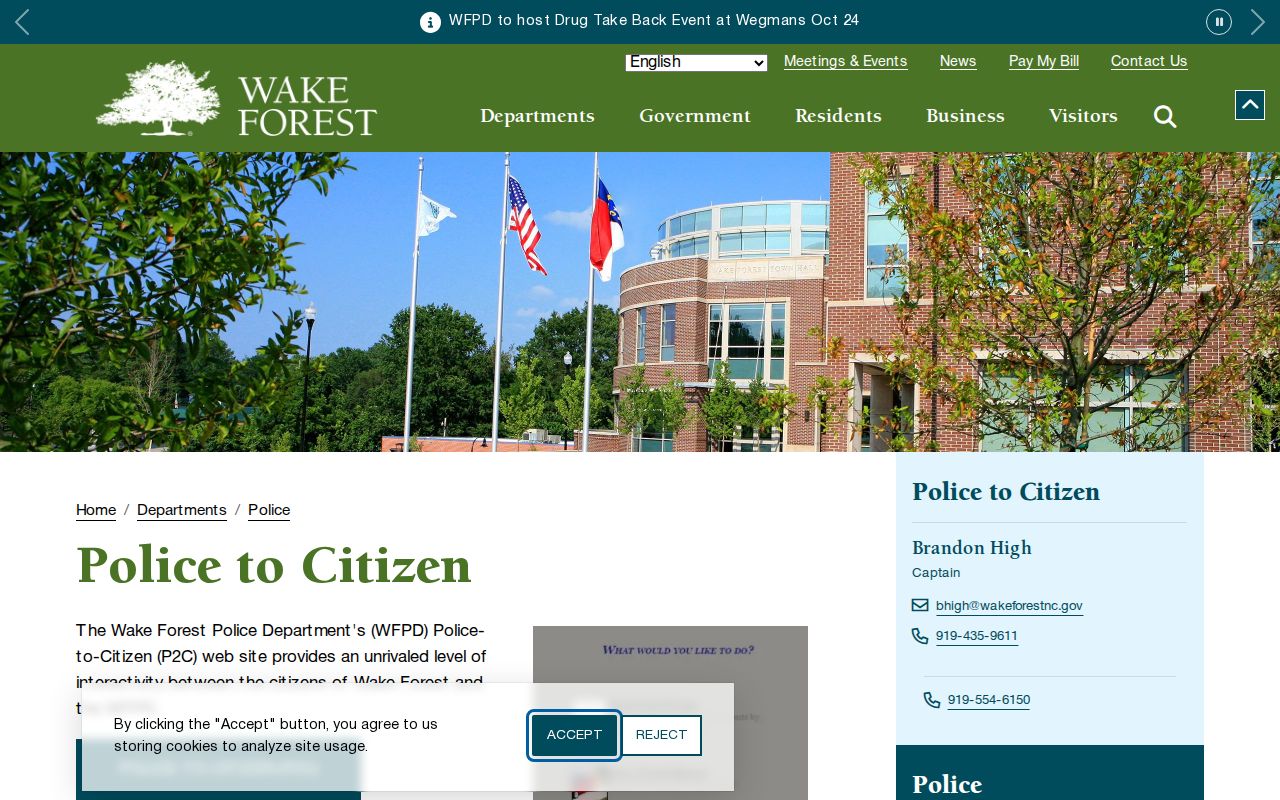
Use the town system for the law-enforcement material it offers. Once a court citation or Wake file number shows up, move to the Portal and the Wake Clerk.
Wake Forest Municipal Court Basics
Wake Forest runs no municipal court of its own. There is no separate city docket. There is no local court clerk, municipal judge calendar, or town court-record search. A Wake Forest court docket for a North Carolina state case is a simple thing. It is a Wake County court record. The town's police-record interface can blur that line. It does not create a parallel court roster.
District Court handles many Wake Forest traffic, infraction, misdemeanor, family, and lower-level civil matters. Superior Court takes felony trials, major civil cases, and applicable appeals. The Wake County Clerk of Superior Court serves both divisions as the local trial-court record keeper. The Portal adds the shared public case-search layer.
Note: Losing a separate Wake Forest city court search takes away nothing. Public access to the Wake state-court file remains full.
Wake Forest -910 Court Files
Save the full number and a Wake Forest court filing gets much easier to find. Wake state-court numbers run in parts. First comes the year, then the letter case type. A six-digit sequence follows, with a final county identifier at the end. That final -910 marks Wake. An exact search beats a broad name search for dependability. A Town report number cannot substitute for this court identifier.
Once a basic search starts, Smart Search offers Advanced Filtering Options. Narrow by Wake location, case category, type, status, or filing dates as your details allow. Portal caps broad results at 200. A Wake Forest reader should tighten the terms. That first large batch is not a complete court list.
- Register of Actions
- The detailed public case history in Portal, also called the Case Summary.
- Case Events
- Chronological court actions that should be checked for a newer hearing or disposition.
- Wake suffix
- The -910 ending on a complete Wake County court file number.
Court Dates and Settings in Wake Forest
Wake Forest court dates live in Wake County channels. Portal's Search Hearings takes a Wake location. It also asks for hearing type, search type, and date range, plus a case, party, attorney, judicial officer, or courtroom entry. The local schedules page adds amended weekly calendars. Longer civil, criminal, District, and Superior schedules appear there too. Check the individual Register against that calendar context before you rely on any Wake Forest setting.
| Date | The current day found in a hearing result or relevant Wake schedule. |
|---|---|
| Time | The listed hearing time, which is not necessarily the court's internal call order. |
| Courtroom | The assigned Wake courtroom or location, not a Wake Forest town facility. |
| Judicial officer | The court context supplied when the hearing search uses that selection. |
| Setting type | The selected civil, criminal, family, probate, or mental-health hearing category. |
Search Hearings will not say whether a hearing is virtual or in person. After any calendar amendment, ask the court for a remote link, the call order, or plain confirmation.
Wake Forest Crash and Court Records
A Wake Forest crash report and a court case record are two different things. The town or state channel named for crash reports keeps the report itself. Any traffic or criminal case that gets filed belongs to the Wake Clerk. It shows up through the state-court process, subject to access rules. A police report existing proves nothing about a court outcome. Likewise, a court result does not certify the full agency report.
Read the document in hand. It may tell you to appear in court. It may show a court citation or Wake case identity. Take the court route. It may list a municipal report number or a P2C instruction. Use that route for the police record. Keep the court matter separate. Either way, hold on to the original numbers, the date, and the issuing agency.
Traffic Tickets in Wake Forest
Don't hunt a Wake Forest traffic ticket on P2C. It lives in the Wake court system as a real case. Search the Portal with the citation number. You can also use the Wake -910 number it becomes, and read the current public events and hearing details there. A police report or crash return can explain what the officer did that day. It cannot tell you whether the court case was continued, disposed of, restricted, or certified by the Clerk.
Wake Administrative Traffic Court is a limited administrative setting. The official procedure is blunt. The issuing officer does not appear there, and contested trials are not held. Follow whatever instructions the active court setting gives you. For the full countywide path, see the Wake traffic tickets page. It walks through court citations and records.
Wake Forest Court Calendar Checks
Two sources beat one for a Wake Forest setting. Case Summary is case-centered and shows the current visible events. The Hearings search and posted Wake calendars are setting-centered. A date coming up soon? Check both again. Then call the Clerk or courtroom staff if a continuance, room change, amended calendar, or remote instruction seems possible.
One quirk deserves a warning. A 12:00 AM time on a converted event is not a midnight Wake Forest court hearing. Wake's earlier eCourts migration left that placeholder on events before February 13, 2023. Trust the newer hearing entry, and confirm the present setting directly with the court.
Where Wake Forest Cases Go
State court matters from Wake Forest go to Wake County courts. A criminal, traffic, infraction, or misdemeanor case travels the Wake County Justice Center channel. Civil cases take the Wake County Courthouse channel instead. A P2C search or police-report request stays on the town route. The systems sit side by side. They stay distinct, though.
Docket flow: Wake Forest law-enforcement event › Wake County Clerk/eCourts court case where filed › Portal Register and Wake calendar › Justice Center criminal route or Courthouse civil route.
A federal filing in Raleigh would carry a federal court number. It runs through PACER, not the Wake Forest town channel and not the Wake Portal. Keep state and federal docket numbers separate.
Wake Forest Court Docket Growth
Wake Forest counted 47,601 residents in the April 1, 2020 Census. That ranked fourth among the selected Wake municipalities. Census also projects 58,147 for 2025. It is not a court-case count. It is also not evidence that a separate town court exists. That is town context, nothing more. Court activity is measured through the Wake countywide court system and its official reports.
Wake Forest's official municipal site covers that town context. It does not run the formal state-court search or the Clerk record counter.
The rule is simple. Use the city portal for city services and agency records; use eCourts plus the Wake Clerk for the court file itself.
Wake Forest Court Record Access Rules
North Carolina court-record law governs public access to any court file that starts in Wake Forest. Under N.C. Gen. Stat. § 7A-109, the Clerk must keep court records, files, dockets, and indexes. They stay open to public inspection unless a law blocks access. Portal shows public case material free of charge. Need an official copy, a file that is not online, or an access answer? Go to the Wake Clerk. A public terminal or counter is available.
Key Rules:
N.C. Gen. Stat. § 7A-109 establishes the Clerk-maintained record and inspection rule.
N.C. Gen. Stat. § 7B-3001 protects juvenile law-enforcement records.
N.C. Gen. Stat. § 7A-95(c) addresses certain nonconfidential clerk or digital-audio records.
Sealed and confidential cases never surface for public Portal users. A P2C result, or the absence of one, changes none of those court access rules.
Wake Forest Clerk Court Requests
Ordering a Wake Forest state court document starts with the details. Give the Wake Clerk the full case number. Also give the case category, the document name and date, and the copy type you want. Portal works well as a locator first. Know the service differences. A plain copy, a certified copy, and an exemplification are three distinct products. A town police report must go through its own custodian. That holds even when the underlying event ties to the court case.
The statewide chart sets the copy fees. First-page preparation costs $2.00. Each additional page or fraction costs $0.25, and a certificate under seal costs $3.00. Confirm the current cost and payment method with the Clerk before ordering.
Note: A Wake Forest police record may give you a town report number. But the Wake Clerk needs the court-facing case identifier to pull the court file.